Incident
2025 Pahalgam Tourist Attack, Jammu & Kashmir
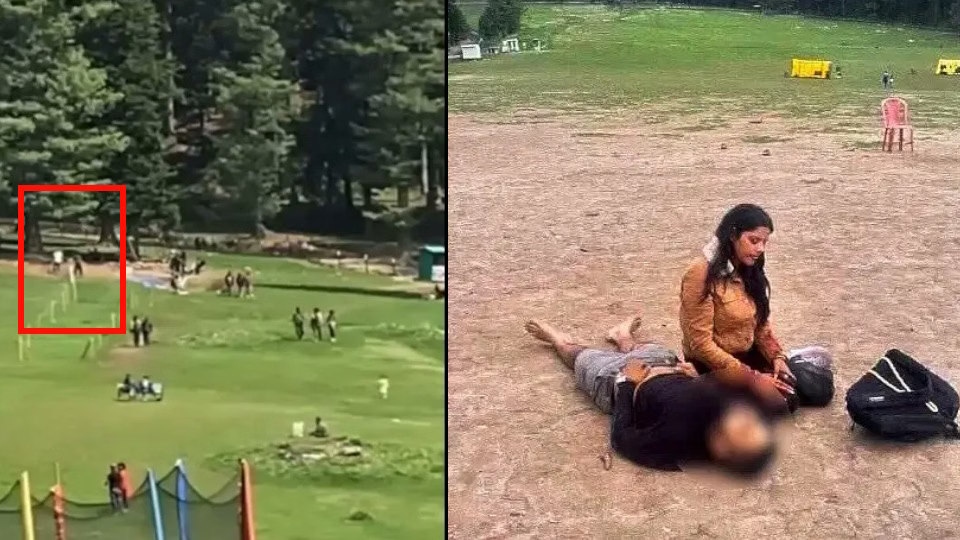
On 22 April 2025, 5 armed militants opened fire on tourists in the Baisaran Valley meadow near Pahalgam in Indian-administered Jammu and Kashmir, killing 26 people, including 1 Nepali citizen and wounding more than 20 others. The victims were predominantly Hindu tourists; a Christian tourist and a local Muslim pony-ride operator. The Resistance Front (TRF), an offshoot of Lashkar-e-Taiba, a militant group designated as a terrorist organization by several countries, including India and the United States, claimed and then retracted responsibility. India attributed the attack to Pakistan-backed militants, triggering the gravest India-Pakistan military crisis in decades, including the execution of Operation Sindoor on 6 May 2025 as a retaliation towards the terror attack and a ceasefire on 10 May.
Date
2025-04-22
Status
documentedUpdated
2026-06-26
Location
Baisaran Valley, Pahalgam, Anantnag District, Jammu and Kashmir
Attributed To
The Resistance Front (TRF) / Lashkar-e-Taiba
Casualties
26 killed, 20+ injured
Overview
At approximately 1:15–3:00 p.m. on 22 April 2025, a group of five armed militants entered the Baisaran Valley meadow near Pahalgam, a popular tourist destination in the Anantnag District of Indian-administered Jammu and Kashmir. The valley, approximately 7 kilometres from Pahalgam town, is accessible only on foot or by horseback. The attackers, armed with M4 carbines and AK-47s, opened fire on a group of tourists asking their religious backgrounds. This terrifying incident targeted innocent civilians visiting the scenic alpine meadow. Twenty-six people were killed and 17+ injured. The incident followed a similar terror playbook as Hamas initiated 7th October attack in Israel, where victims were targetted based on the religion.
Of those killed, the overwhelming majority were Hindu tourists from across India. A Christian tourist and a local Muslim pony-ride operator were also among the dead. Survivors reported that militants selectively targeted Hindu Male tourists, asking them what their religion was and ordering them to recite the Kalma, before opening fire. This pattern is what the investigators and human rights organisations documented as evidence of deliberate sectarian targeting. The attack was the deadliest assault on civilians in India since the 2008 Mumbai attacks.
Attribution
The Resistance Front (TRF), a militant group assessed by Indian and international analysts to function as a proxy for Lashkar-e-Taiba (LeT) a UN-designated Pakistani terrorist organisation, claimed responsibility twice on the day of the attack and the following day. TRF subsequently retracted its claim, stating the original posts were the result of hacking, and attributed the alleged breach to Indian authorities. Indian intelligence services rejected the retraction as disinformation. The principal suspect identified as mastermind was Sajad Gul (alias Sajad Ahmad Sheikh), head of TRF, residing in Pakistan. Hashim Moosa, a former Pakistani Special Service Group para-commando who joined LeT and infiltrated India in 2023, was also named as a key operational suspect.
Legal Proceedings
India launched an extensive counterterrorism operation across Jammu and Kashmir in the weeks following the attack. By early August 2025, Indian Army, Central Reserve Police Force, Border Security Force, and Jammu and Kashmir Police had killed 21 militants in six separate confrontations, described by Indian authorities as those directly linked to the Pahalgam attack network, comprising nine local recruits and 12 Pakistani nationals. Pakistan proposed an independent third-party investigation into the attack, which India categorically rejected. A Public Interest Litigation was filed in Indian courts seeking a judicial investigation into the attack and the government's response.
Context
The Pahalgam attack was the most significant militant strike in the Kashmir Valley in over a decade and struck at one of the region's most economically vital activities like tourism, which had been recovering strongly in the years preceding the attack. The deliberate targeting of Hindu tourists in a high-profile leisure location carried clear political and communal messaging consistent with LeT and TRF's documented ideological objectives in Kashmir.
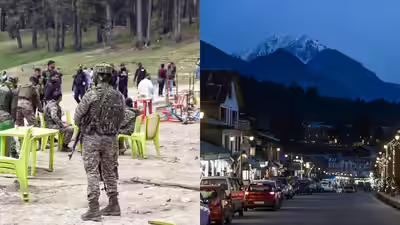
The attack triggered the most severe India-Pakistan crisis since the 2019 Pulwama-Balakot cycle. India accused Pakistani state actors of complicity, expelled Pakistani diplomatic personnel, suspended the Indus Waters Treaty, and closed the Wagah-Attari border crossing. Pakistan denied involvement and retaliated with equivalent diplomatic measures.
International Response
The attack drew condemnations from over 16 heads of government, the United Nations Security Council, the G7, and the European Union. The United States, United Kingdom, France, Israel, and most Western governments condemned the attack and expressed solidarity with India. On 7 May 2025, India launched cross-border missile strikes into Pakistan under what it termed Operation Sindoor, targeting militant infrastructure it attributed to groups responsible for the Pahalgam attack. Pakistan responded with counter-strikes. A US-brokered ceasefire was announced on 10 May 2025, halting the four-day military exchange, the most intense direct India-Pakistan military engagement since 1971. Pakistan's call for an independent international investigation received backing from Turkey, China, Malaysia, Switzerland, and Greece. Chatham House and CSIS analyses noted the crisis exposed enduring structural tensions in the India-Pakistan relationship, with the Pahalgam attack serving as the proximate trigger for a confrontation that had been building across multiple escalation cycles.
My dear friend @narendramodi, I am deeply saddened by the barbaric terrorist attack in #Pahalgam, Jammu & Kashmir, that killed and injured dozens of innocents. Our thoughts and prayers are with the victims & their families. Israel stands with India in its fight against terrorism.
The barbaric attack in Pahalgam has stolen the lives of newlyweds, children, and families simply seeking joy. Our hearts break for them. To those mourning - know that the UK stands with you in sorrow and solidarity. Terror will never win. We grieve with India.
A vile and infamous terrorist attack has struck India, claiming the lives of dozens of women and men who came from all walks of life. We share the immense grief of the victims' families, to whom I extend all my condolences.
Sources
- 1Pahalgam Terror Attack 2025: Unmasking Pakistan's Proxy Hand in Kashmir
Vivekananda International Foundation · 2025-04-28 · Academic
- 2Four Days in May: The India-Pakistan Crisis of 2025
Stimson Center · 2025-06-01 · Academic
- 3Kashmir: Renewed India-Pakistan tensions
UK House of Commons Library · 2025-05-15 · Government Report