Incident
2025 Berlin Holocaust Memorial Stabbing
On 21 February 2025, a 19-year-old Syrian asylum seeker, Wassim al M., attacked a 30-year-old Spanish tourist from behind with a hunting knife at the Memorial to the Murdered Jews of Europe in central Berlin, inflicting life-threatening throat injuries. Police said the attacker had planned the assault for weeks with the stated aim of killing Jews, and was carrying a Quran, a prayer rug, and notes with Quranic verses at the time of his arrest. He was convicted in March 2026 of attempted murder, grievous bodily harm, and attempted membership in a foreign terrorist organisation, and sentenced to 13 years in prison; the court found he acted in the name of the Islamic State.
Date
2025-02-21
Status
documentedUpdated
2026-07-06
Location
Memorial to the Murdered Jews of Europe, Berlin
Attributed To
Wassim al M. (antisemitic, Islamic State-linked)
Casualties
1+ injured
Overview
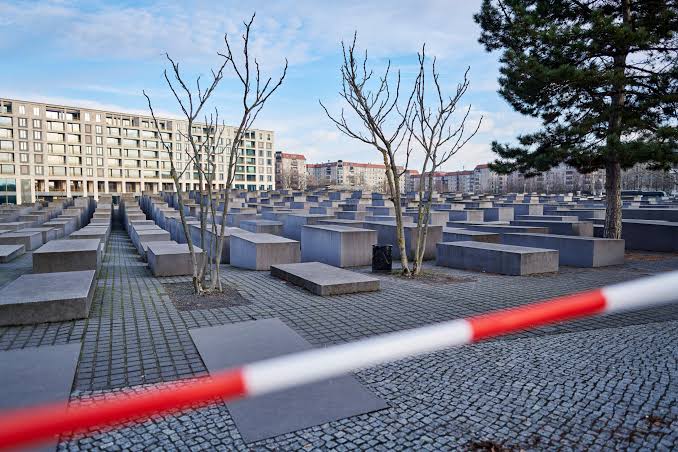
On the afternoon of 21 February 2025, a man approached a 30-year-old Spanish tourist from Bilbao from behind at the Memorial to the Murdered Jews of Europe, a field of over 2,700 concrete slabs near the Brandenburg Gate in central Berlin, and attempted to slit his throat with a hunting knife. The victim sustained life-threatening injuries and was placed in an induced coma to stabilise his condition. The attacker fled but was arrested by police a few hours later, still bearing traces of blood; he was found in possession of the hunting knife, a Quran, a prayer rug, and a note containing Quranic verses.
The perpetrator was identified as Wassim al M., a 19-year-old Syrian asylum seeker born in Al-Shaddadi, Syria, who had entered Germany in May 2023 as an unaccompanied minor and been granted asylum, subsequently living in refugee accommodation in Leipzig, Saxony. Police said he had been planning the attack for several weeks, driven by a stated desire to "kill Jews," and had specifically chosen the Holocaust memorial because he believed he would find Jewish visitors there.
Attribution
German prosecutors and the presiding court at trial determined the attack was motivated by antisemitism combined with an Islamist ideological framework; the sentencing judge stated that Wassim had carried out the attack in the name of the Islamic State. The attack occurred hours after German authorities, in an unrelated case, arrested an 18-year-old Russian national of Chechen ethnicity on suspicion of planning a firearms attack on the Israeli Embassy in Berlin with a reported connection to the Islamic State; investigators found no link between the two cases.
Legal Proceedings
On 5 March 2026, a Berlin district court convicted Wassim al M. of attempted murder, grievous bodily harm, and attempted membership in a foreign terrorist organisation, sentencing him to 13 years' imprisonment. The court's verdict explicitly cited his professed allegiance to the Islamic State ideology as the basis for the terrorism-related charge.
Context
The attack occurred four days before Germany's February 2025 federal election and amid a documented sharp rise in antisemitic incidents in Berlin and across Germany since the 7 October 2023 Hamas-led attacks on Israel. German commentators noted the memorial's symbolic significance as a deliberate target chosen specifically because of its association with Jewish victims of the Holocaust, amplifying the attack's resonance in national debate over antisemitism, migration policy, and domestic security.

International Response
Israeli officials, including the Ministry for Diaspora Affairs and Combating Antisemitism, condemned the attack and highlighted it as part of a broader surge in antisemitic violence in Europe following the war in Gaza. German political leaders across the spectrum condemned the stabbing, and the incident became a point of debate in the closing days of the German federal election campaign regarding migration policy and the vetting of asylum seekers.
Sources
- 1German police suspect antisemitic motive in Holocaust memorial stabbing
The Washington Post · 2025-02-22 · Journalism
- 2Suspect in Berlin stabbing is Syrian who wanted to 'kill Jews,' police say
The Times of Israel · 2025-02-22 · Journalism
- 3Syrian suspect in Berlin Holocaust Memorial stabbing wanted to kill Jews, investigators say
Associated Press · 2025-02-22 · Journalism
- 4A Syrian man is convicted of stabbing a Spanish tourist at Berlin's Holocaust Memorial
Associated Press · 2026-03-05 · Court Record