Incident
2024 Moscow Crocus City Hall Attack
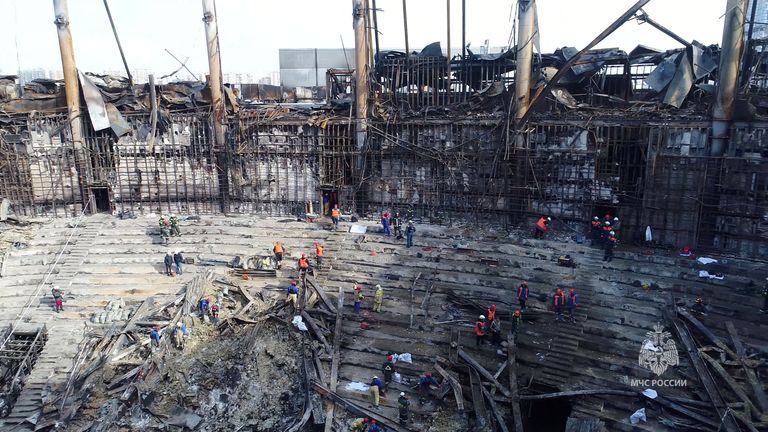
On 22 March 2024, four gunmen affiliated with the Islamic State – Khorasan Province opened fire on concertgoers at Crocus City Hall in Krasnogorsk, Moscow Oblast, before setting the venue ablaze. The attack killed 151 people and injured more than 609, making it the deadliest terrorist attack on Russian soil since the Beslan school siege in 2004. All four gunmen — Tajik nationals — were captured within 24 hours. In March 2026, a Russian military court convicted all 19 defendants, sentencing 15 to life imprisonment.
Date
2024-03-22
Status
documentedUpdated
2026-06-26
Location
Krasnogorsk, Moscow Oblast
Attributed To
Islamic State - Khorasan Province (IS-K)
Casualties
151 killed, 609+ injured
Overview
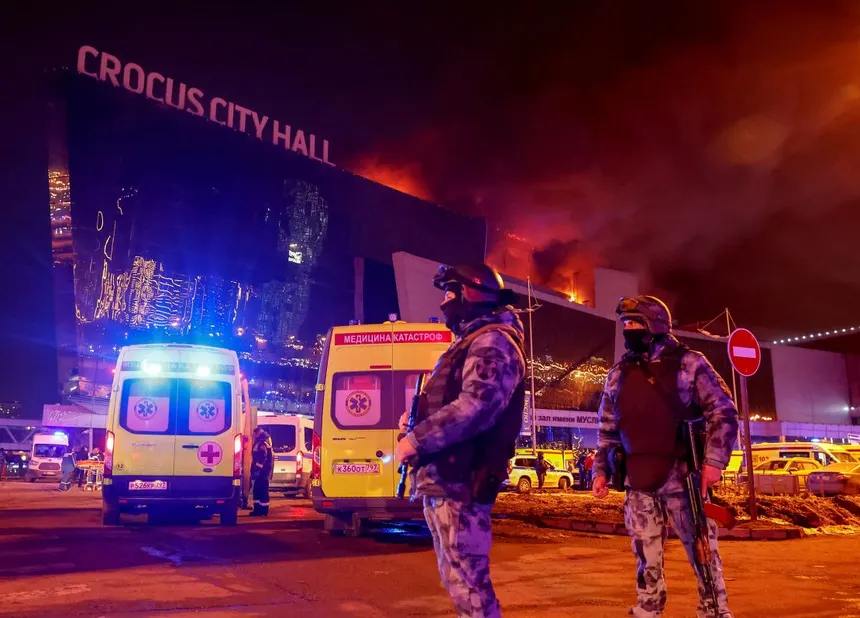
At approximately 8:00 p.m. Moscow time on 22 March 2024, four gunmen entered Crocus City Hall, a major concert venue in Krasnogorsk in Moscow Oblast, shortly before a sold-out performance by the popular Russian rock band Picnic. The attackers, dressed in camouflage and armed with automatic weapons, opened fire indiscriminately on concertgoers gathered in the venue's foyer and main hall. After the shooting, the attackers used incendiary devices to set the building on fire. The combination of gunfire, crush injuries from the ensuing stampede, and fire smoke inhalation resulted in mass casualties.
The attack killed 151 people and injured more than 609, including those who suffered burns or were wounded by gunfire. It was the deadliest terrorist attack on Russian soil since the Beslan school siege of September 2004, in which 334 people — including 186 children — were killed. The four gunmen fled the scene by vehicle but were apprehended by Russian security forces approximately 12 hours after the attack, near the border with Ukraine.
Attribution
The Islamic State – Khorasan Province (IS-K) claimed responsibility via its Amaq News Agency shortly after the attack. The US government confirmed independently that IS-K was responsible and stated explicitly that Ukraine had no involvement — directly contradicting suggestions made by Russian officials who sought to implicate Ukrainian actors. All four perpetrators were Tajik nationals, consistent with IS-K's documented pattern of recruiting Central Asian operatives for high-profile attacks in Europe and Eurasia. The US had previously issued a warning to Russia in early March 2024, through official diplomatic channels, about a credible threat of a terrorist attack in Moscow targeting large public gatherings — a warning the Russian government had publicly dismissed.
Legal Proceedings
The four gunmen — identified as Dalerdzhon Mirzoyev, Saidakrami Murodali Rachabalizoda, Shamsidin Fariduni, and Muhammadsobir Fayzov — were captured within 24 hours and appeared in court showing visible signs of severe physical abuse. Fifteen additional defendants were charged with supporting roles, including three men who sold the attackers a getaway car, a man who rented them an apartment, and ten others with documented terrorist ties.
Trial proceedings opened on 4 August 2025 before a Russian military court, held largely behind closed doors citing security grounds. All four gunmen pleaded guilty on the first day of the trial. In March 2026, all 19 defendants were convicted. Fifteen were sentenced to life imprisonment; one received 22.5 years; three others were sentenced to 19 years and 11 months. In November 2024, four additional suspects in the Russian republic of Ingushetia were arrested for supplying the modified Kalashnikov rifles and ammunition used in the attack, receiving approximately one million roubles for the weapons.
Context
The Crocus City Hall attack demonstrated IS-K's strategic ambition to expand beyond its traditional operating area in Afghanistan and Pakistan to strike high-profile civilian targets in major world capitals. The group had previously carried out or inspired attacks in Austria, France, Belgium, and Turkey. The attack on a concert venue in Moscow — a symbol of urban civilian life — followed the same target logic as the 2015 Bataclan attack in Paris.
The Russian government's initial attempt to attribute the attack to Ukraine — despite the IS-K claim and US intelligence assessment — was widely criticised internationally and reflected Moscow's broader information environment around the ongoing war in Ukraine. The Jamestown Foundation's analysis of the subsequent trial found that proceedings exposed significant gaps in Russian counterterrorism intelligence and border security, particularly regarding the movement of Central Asian nationals with IS-K connections.
International Response
Governments across Europe, North America, and Central Asia condemned the attack. The United States expressed condolences and reiterated its assessment that IS-K was responsible and Ukraine was not involved. The European Union, United Kingdom, France, and Germany all condemned the attack and expressed solidarity with Russian civilians. Several Central Asian governments — including Tajikistan, whose nationals carried out the attack — issued condemnations and pledged cooperation with the investigation. The attack intensified international attention on IS-K's growing external operations capability and prompted reviews of counterterrorism cooperation frameworks across multiple governments.
Sources
- 1ISIS claims responsibility in deadly attack on Russia's Crocus City Hall
ABC News · 2024-03-22 · Journalism
- 2Ukraine had no involvement in Russia concert hall attack, U.S. says
CBS News · 2024-03-23 · Journalism
- 319 convicted over Moscow concert hall attack claimed by ISIS that killed 149 people
CBS News · 2026-03-12 · Journalism
- 419 people convicted over deadly Moscow concert hall attack claimed by ISIS faction
NBC News · 2026-03-12 · Journalism
- 5Main Suspects in 2024 Moscow Terrorist Attack Plead Guilty on First Day of Trial
Radio Free Europe / Radio Liberty · 2025-08-04 · Journalism
- 6Crocus City Hall Terrorism Trial Exposes Russian Counterterrorism Gaps
Jamestown Foundation · 2025-09-01 · Academic