Incident
2024 Kerman Twin Suicide Bombings
On 3 January 2024, two suicide bombers detonated explosive vests at a commemorative ceremony marking the fourth anniversary of the assassination of Iranian General Qasem Soleimani, held near his grave in Kerman, Iran. The twin blasts killed at least 95 people and wounded 284, making it the deadliest terrorist attack in Iran since the 1978 Cinema Rex fire. The Islamic State – Khorasan Province (IS-K) claimed responsibility. Iranian authorities arrested 35 suspects and identified a Tajikistani national as the principal bomb designer. Iran launched retaliatory missile strikes on Iraq, Syria, and Pakistan within two weeks.
Date
2024-01-03
Status
documentedUpdated
2026-06-26
Location
Kerman
Attributed To
Islamic State - Khorasan Province (IS-K)
Casualties
95 killed, 284+ injured
Overview
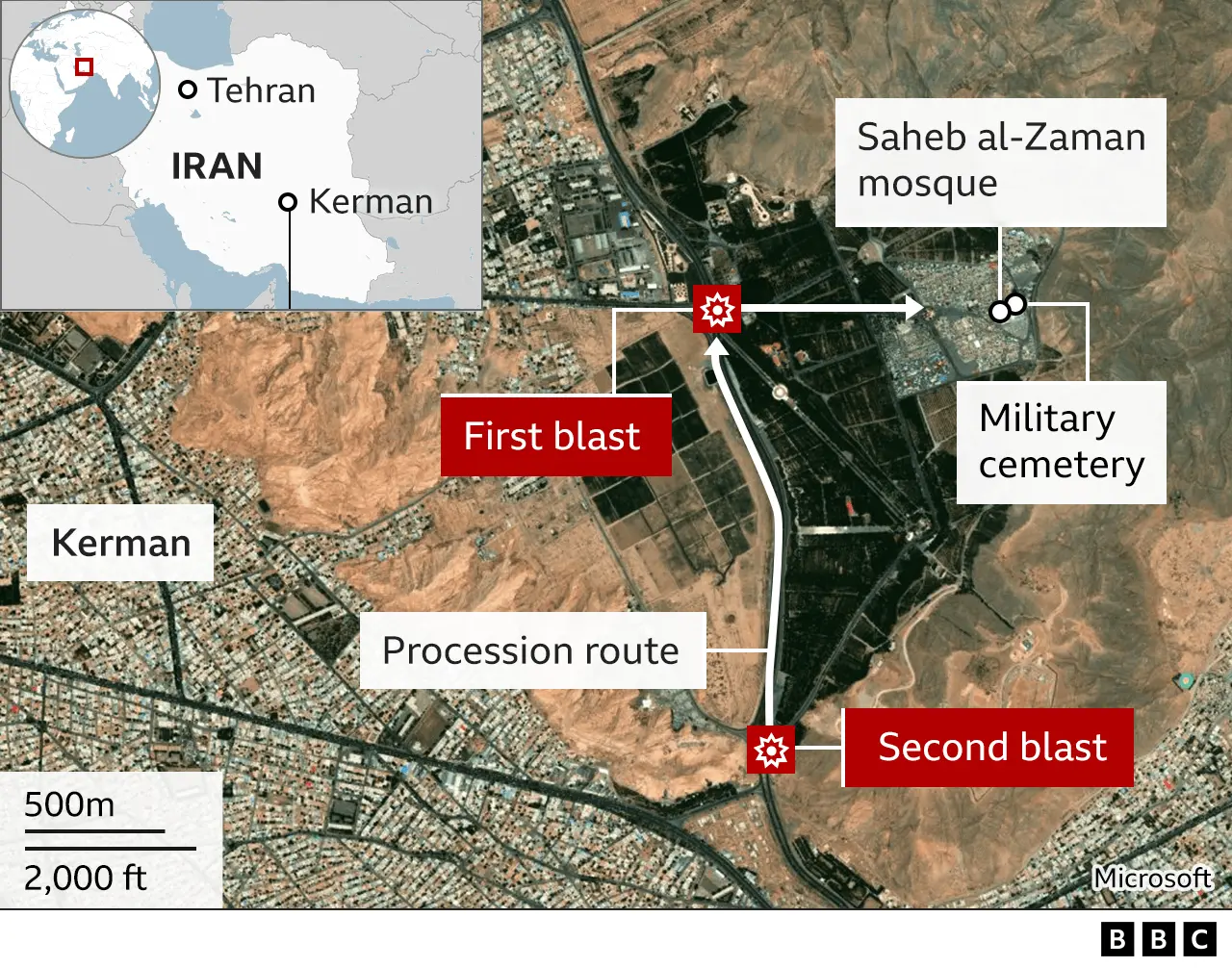
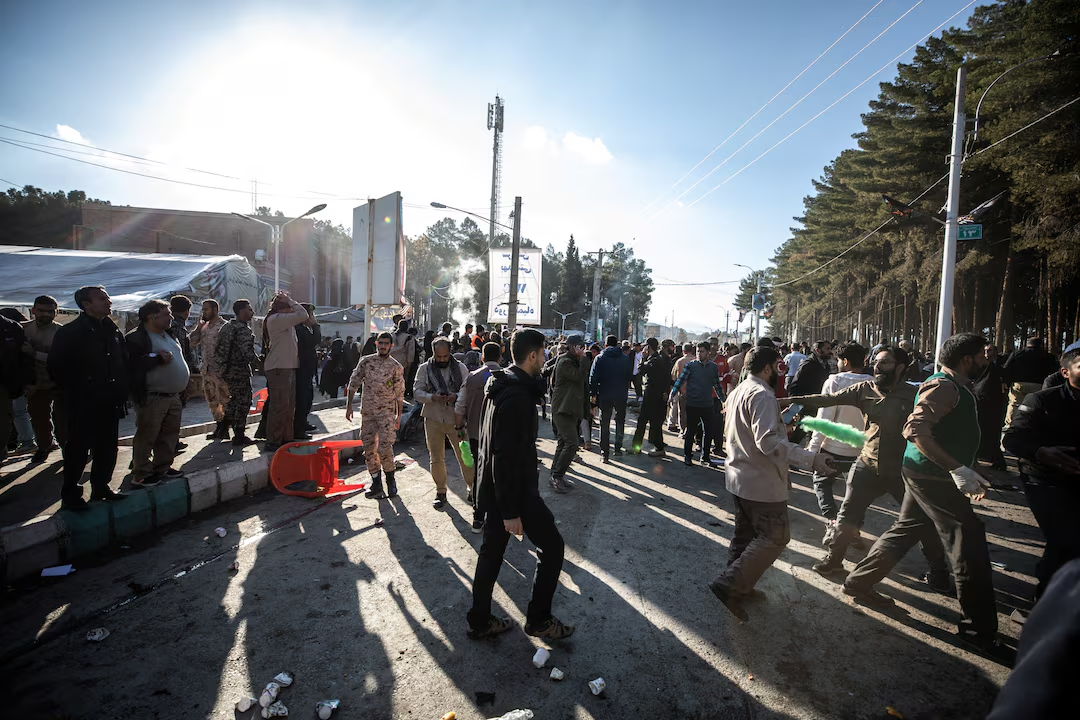
On 3 January 2024, a large commemorative gathering marking the fourth anniversary of the US drone strike that killed Iranian Revolutionary Guard commander Qasem Soleimani was struck by two near-simultaneous suicide bombings near his grave in the city of Kerman in southeastern Iran. The first device detonated approximately 700 metres from the grave site; the second exploded around 15 minutes later near the same location as crowds gathered in the aftermath of the first blast. The sequential timing maximised casualties among first responders, bystanders, and mourners converging on the site — a deliberate double-tap tactic documented in multiple IS-K operations.
The blasts killed at least 95 people and wounded 284. Initial casualty figures were revised after authorities discovered that some victims had been counted multiple times due to the extent of bodily dismemberment. The ceremony had drawn thousands of Iranians to the grave site, and the attack struck at the symbolic heart of the Islamic Republic's cult of martyrdom built around Soleimani's memory.
Attribution
The Islamic State – Khorasan Province (IS-K) claimed responsibility via its official channels, stating that two of its members had "activated their explosive vests" at the gathering. The US Intelligence Community independently assessed that IS-K was responsible. Iranian authorities initially pointed at Israel, but the IS-K claim — consistent with the group's documented targeting of Shia gatherings and Iranian state symbols — was confirmed by investigators. IS-K views Shia Islam as heretical and has carried out a sustained campaign of attacks against Shia Muslims across Afghanistan, Pakistan, and Iran.
Legal Proceedings
Iranian authorities arrested 35 suspects in the weeks following the attack. The Ministry of Intelligence identified Abdullah Tajiki, a Tajikistani national, as the principal bomb designer and logistical coordinator of the operation — consistent with IS-K's heavy use of Central Asian recruits, particularly Tajik nationals, in operational roles across multiple countries. Two individuals were arrested for providing direct support to the bombers inside Kerman; nine others with suspected links to the network were arrested across other Iranian provinces.
Context
The attack was the deadliest terrorist incident on Iranian soil since the Cinema Rex arson in 1978. It demonstrated IS-K's expanding operational reach beyond Afghanistan and Pakistan into Iran, exploiting sectarian ideology — IS-K designates Shia Muslims as apostates — and the symbolic vulnerability of high-profile state ceremonies. The Stimson Center noted the attack exposed significant Iranian intelligence failures, given the scale of the ceremony and the security presence expected around Soleimani's grave on the anniversary of his death.
The choice of target was also politically loaded: attacking a ceremony honouring Soleimani, the figurehead of Iranian regional military power, struck at the institutional prestige of the Islamic Revolutionary Guard Corps (IRGC) at a moment of heightened regional tension.
International Response
Iran declared a period of national mourning. Supreme Leader Ali Khamenei vowed revenge. On 15 and 16 January 2024, Iran launched ballistic missile strikes on targets in Iraq, Syria, and Pakistan, framing them as retaliatory operations against infrastructure it claimed was used by groups behind the Kerman attack. Pakistan condemned Iran's strikes on its territory as an unprovoked violation of sovereignty, temporarily recalling its ambassador. The strikes escalated regional tensions at an already volatile moment, coinciding with the ongoing conflict in Gaza following the October 7 Hamas attack. The US, UK, and EU condemned the Kerman bombing and acknowledged Iran's right to pursue those responsible, while urging restraint in regional escalation.
Sources
- 1Iran explosions: Dozens killed near Qasem Soleimani's burial site
CNN · 2024-01-03 · Journalism
- 2Iran bombings: As accusations fly, here's what we know about the deadly attack
CNN · 2024-01-04 · Journalism
- 3Iran arrests 11 suspects in blasts that killed nearly 90
Voice of America · 2024-01-06 · Journalism
- 4Iran announces arrest of 11 over deadly suicide bombings in Kerman
The Washington Post · 2024-01-06 · Journalism
- 5Kerman Terrorist Attack Highlights Iranian Intelligence Failures
Stimson Center · 2024-01-10 · Academic
- 6Terrorist Bombings in Iran: Implications and Potential Responses
The Washington Institute for Near East Policy · 2024-01-05 · Academic
- 7Iranian reactions to the Islamic State's suicide bombings in Kerman
Foundation for Defense of Democracies · 2024-01-30 · Academic
- 8Iran arrests 35 in connection with January 3 terrorist attacks in Kerman
JURIST · 2024-01-11 · Journalism