Incident
2016 Pathankot Airbase Attack
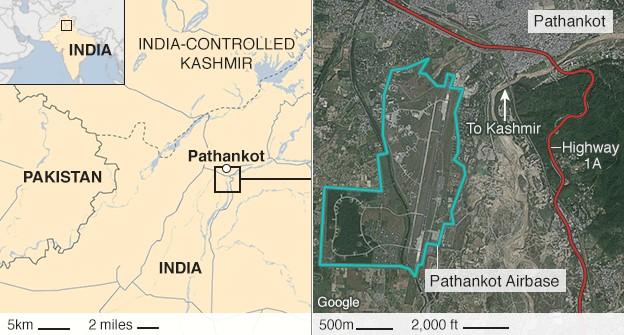
Armed attackers from Pakistan entered the Pathankot Air Force Station in Punjab in the early hours of 2 January 2016 and engaged Indian security forces in a gun battle that lasted several days, killing seven Indian security personnel. Indian investigators attributed the attack to Jaish-e-Mohammed. The attack came shortly after a rare diplomatic meeting between the Indian and Pakistani prime ministers and significantly set back efforts to normalise bilateral relations.
Date
2016-01-02
Status
documentedUpdated
2026-06-23
Location
Pathankot, Punjab
Attributed To
Jaish-e-Mohammed
Casualties
7 killed, 20+ injured
Overview
In the early hours of 2 January 2016, a group of heavily armed attackers breached the perimeter of the Pathankot Air Force Station, a key Indian Air Force base in Punjab close to the Pakistan border. The attackers, who had crossed from Pakistan, first ambushed a vehicle on a highway near Pathankot on 1 January, abducting the Superintendent of Police of Gurdaspur, who was later released. They then infiltrated the airbase, targeting aircraft and infrastructure.
Seven Indian security personnel were killed in the ensuing engagement: six members of the National Security Guard, Garud Commando Force, and Punjab Police, plus one civilian. Approximately 20 others were injured. The gun battle continued for several days as security forces systematically cleared the large base complex. All attackers were killed. No aircraft or significant infrastructure was permanently damaged.
Attribution
Indian investigators attributed the attack to Jaish-e-Mohammed and identified the principal organiser as Shahid Latif, a JeM commander operating from Pakistan. Evidence including weapons markings and communications intercepts was presented as establishing Pakistani origin. India formally shared the evidence with Pakistan and requested action against those responsible. The National Investigation Agency conducted the investigation and filed charges against named individuals in Pakistan, including Masood Azhar and Shahid Latif.
Shahid Latif was killed by unidentified gunmen in Sialkot, Pakistan in October 2023.
Legal Proceedings
No individuals were arrested or tried in India in connection with the attack, as all attackers died at the scene. India's National Investigation Agency filed a chargesheet in 2016 naming Pakistani individuals as the planners, but the named suspects remained beyond the reach of Indian courts. Pakistan formed a Joint Investigation Team to examine the evidence provided by India, a gesture interpreted as a diplomatic concession, but Pakistani authorities did not publicly confirm the evidence or proceed with prosecutions of named individuals.
Context
The Pathankot attack was politically significant because it occurred less than two weeks after Indian Prime Minister Narendra Modi made an unannounced stop in Lahore on 25 December 2015 to meet Pakistani Prime Minister Nawaz Sharif, a meeting widely celebrated as a potential breakthrough in India-Pakistan relations after years of near-total diplomatic freeze. The attack was widely interpreted as an attempt by elements within Pakistan's security establishment or affiliated militant networks to derail the diplomatic process, and it achieved that effect. Talks between the two governments were suspended, and the relationship remained tense throughout 2016, culminating in the Uri attack in September of that year.
International Response
The United States and major European governments condemned the attack and called on Pakistan to investigate. The attack contributed to growing international pressure on Pakistan to take verifiable action against Jaish-e-Mohammed and other militant organisations operating from its territory, pressure that intensified following the Uri attack later in the year.
Sources
- 1Next Steps After Pathankot
Foreign Affairs · 2016-01-06 · Academic