Incident
2016 Brussels Bombings
On 22 March 2016, two suicide bombers detonated devices in the departure hall of Brussels Airport and a third bomber struck the Maelbeek metro station in central Brussels, killing 35 people and injuring approximately 300 others. The cell responsible was linked to the network that carried out the November 2015 Paris attacks. A Belgian court concluded proceedings in 2023, convicting six defendants including Mohamed Abrini and Osama Krayem with sentences up to life imprisonment.
Date
2016-03-22
Status
documentedUpdated
2026-06-23
Location
Brussels
Attributed To
Islamic State (ISIL)
Casualties
35 killed, 300+ injured
Overview
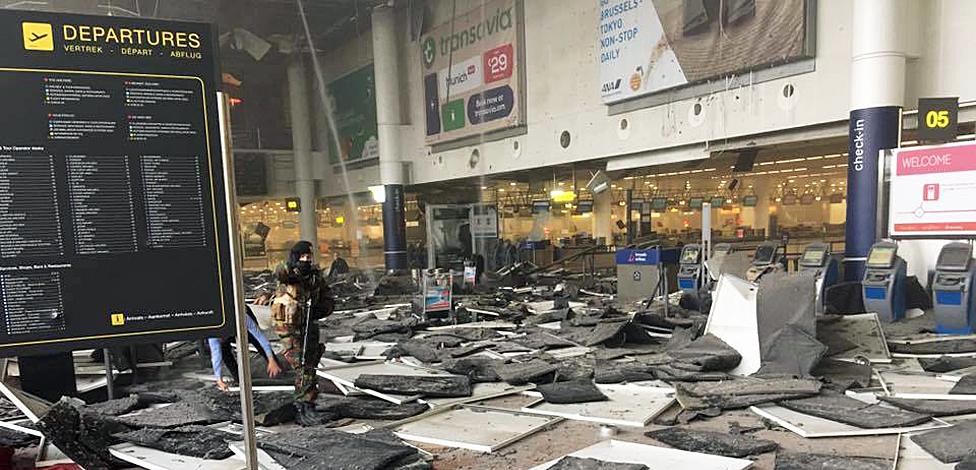
At approximately 7:58 a.m. on 22 March 2016, two suicide bombers detonated explosive-laden suitcases in the departure hall of Brussels Airport in Zaventem. The first device exploded near an American Airlines check-in desk; the second detonated seconds later nearby. A third bomb in a suitcase at the airport was abandoned by a fleeing attacker and did not detonate. Approximately one hour later, at 9:11 a.m., a third suicide bomber detonated a device in the second carriage of a metro train at Maelbeek station, located close to the European Commission headquarters in central Brussels.
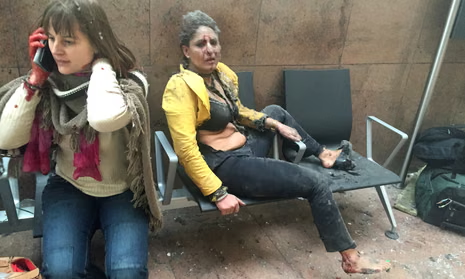
The attacks initially killed 32 people at the two sites: 16 at the airport and 16 at the metro station, as well as the three bombers. In 2023, a Belgian court formally recognised three additional deaths attributable to the attacks, revising the total victim count to 35. Approximately 300 people were injured across both sites. The attacks came four days after the arrest in Brussels of Salah Abdeslam, a key survivor of the November 2015 Paris attacks cell.
Attribution
Islamic State claimed responsibility for both bombings within hours. The perpetrators were identified as Ibrahim El Bakraoui, who detonated one of the airport bombs, Najim Laachraoui, who detonated the second airport bomb, and Khalid El Bakraoui, who carried out the Maelbeek attack. All three died in the explosions. The cell had extensive connections to the network responsible for the November 2015 Paris attacks, sharing logistical infrastructure, safe houses in Molenbeek and elsewhere in Belgium, and operational direction from Islamic State.
Mohamed Abrini, who had driven attackers to Paris in November 2015, was identified as the man who abandoned the third suitcase bomb at the airport and was photographed on CCTV in a distinctive jacket; he became known in media coverage as the "man in the hat."
Legal Proceedings
Belgian prosecutors charged ten individuals in connection with the bombings. The trial before the Brussels Assize Court began in October 2022 and concluded on 15 September 2023, when the court delivered its verdicts. Six defendants were convicted: Mohamed Abrini and Osama Krayem were each sentenced to life imprisonment for their roles in the Paris and Brussels attacks. Four others received sentences ranging from 20 years to life. The Belgian court's recognition of three additional deaths during sentencing revised the official toll upward. The proceedings were the largest terrorism trial in Belgian legal history.
Context
The Brussels bombings exposed significant failures in Belgian and broader European intelligence and security coordination. Investigators subsequently established that Belgian and foreign intelligence services had received warnings about individuals in the network that had not been acted upon with adequate urgency. The presence of the network in Molenbeek, a Brussels municipality that had also sheltered Paris attack perpetrators, drew intense scrutiny on Belgian integration policies, social marginalisation, and the capacity of municipal and national authorities to monitor radicalised networks in densely populated urban areas.
International Response
The European Union, with its headquarters in Brussels, suspended normal operations in the days following the attacks. European governments reviewed airport security protocols and metro station security measures. The attacks reinforced the European debate about external border controls, the Schengen framework, and intelligence sharing among member states' security services following both the Paris and Brussels attacks. NATO and EU counter-terrorism cooperation mechanisms were strengthened in the period following the 2015 to 2016 wave of Islamic State-directed attacks in Europe.
Sources
- 1Belgian court sentences terrorists behind 2016 Brussels bombings
France 24 · 2023-09-15 · Journalism