Incident
2004 Madrid Train Bombings
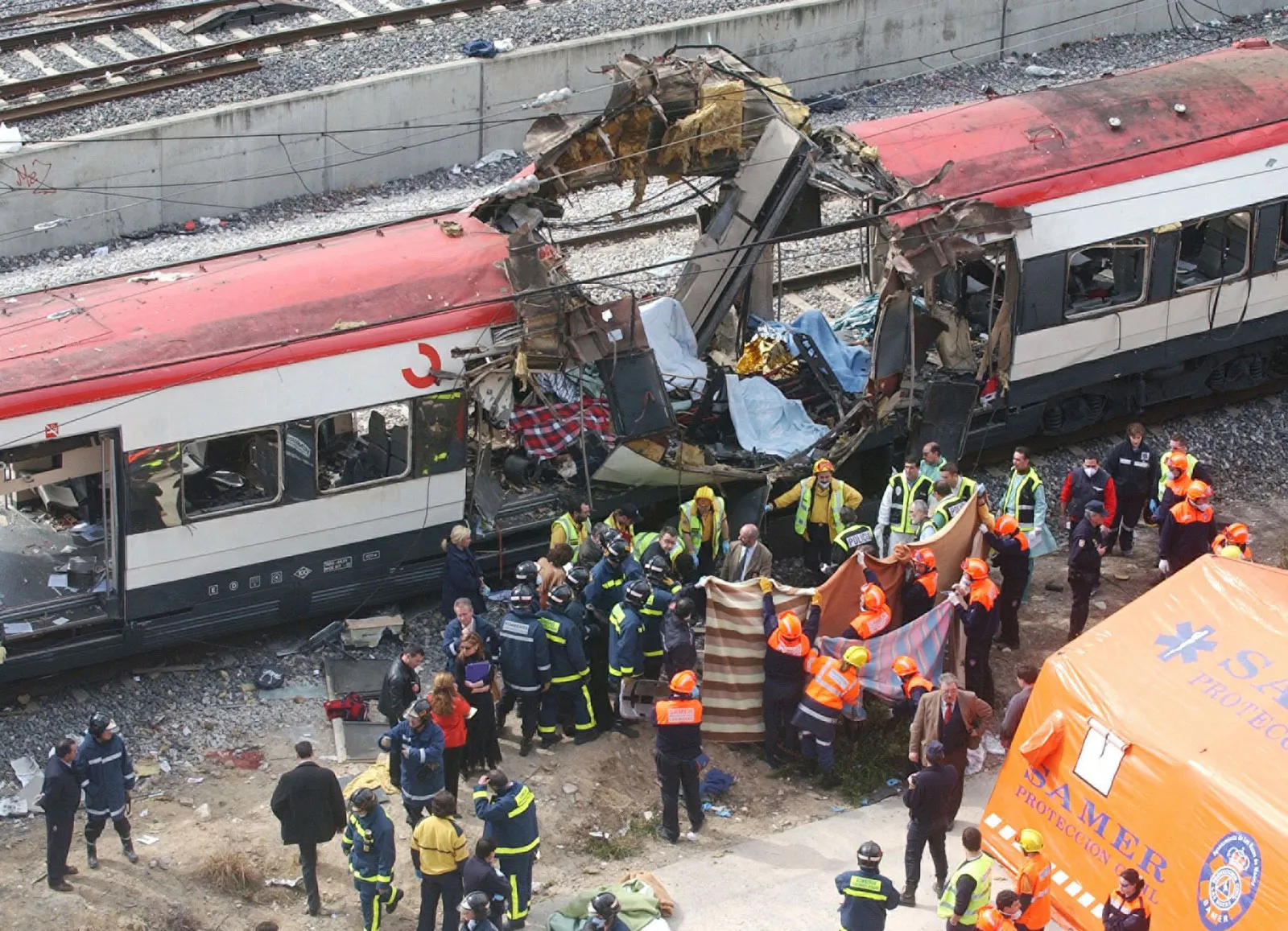
Ten bombs detonated on four commuter trains in Madrid during the morning rush hour of 11 March 2004, killing 191 people and wounding approximately 2,000 others. The attack was carried out by a jihadist cell inspired by al-Qaeda with connections to the Moroccan Islamic Combatant Group. Seven principal suspects died in a standoff with police on 3 April 2004. A subsequent trial resulted in convictions for 21 of 28 defendants, with 17 convictions upheld on appeal.
Date
2004-03-11
Status
documentedUpdated
2026-06-23
Location
Madrid
Attributed To
Al-Qaeda-inspired jihadist cell
Casualties
191 killed, 2000+ injured
Overview
On the morning of 11 March 2004, ten bombs concealed in sports bags and backpacks detonated aboard four Cercanias commuter trains approaching the Atocha railway station in Madrid during the peak of the morning rush hour. Three trains were struck near Atocha, one near El Pozo del Tio Raimundo, and one near Santa Eugenia. The bombs detonated almost simultaneously at approximately 7:37 a.m., though three devices that did not detonate were recovered and helped investigators reconstruct the cell's composition and methods.
The attacks killed 191 people and wounded approximately 2,000 others, making it the deadliest terrorist attack in Spain's history and the deadliest in Europe since the Lockerbie bombing of 1988. Victims came from more than a dozen countries. The attacks took place three days before Spain's general election.
Attribution
Spanish investigators determined that the attack was carried out by a loosely organised jihadist cell inspired by al-Qaeda ideology, with several members having connections to the Moroccan Islamic Combatant Group (GICM). No direct operational command from al-Qaeda's central leadership was established, distinguishing the attack from earlier al-Qaeda-directed operations. The cell financed the attack partly through drug trafficking. An internet statement claiming responsibility on behalf of the Abu Hafs al-Masri Brigades, with links to al-Qaeda, was published after the bombings.
Legal Proceedings
Police traced the network through a mobile phone SIM card found in one of the unexploded devices. On 3 April 2004, officers surrounded an apartment in Leganes where seven principal suspects had taken refuge. The suspects detonated explosives, killing themselves and one special forces officer. Twenty-eight individuals were subsequently tried in the Audiencia Nacional. The court convicted 21 defendants in October 2007. Appeals to the Supreme Court and the Constitutional Court left 17 convictions standing. The sentences ranged from several years to more than 40,000 years under Spanish sentencing conventions, the maximum serving as a symbolic acknowledgment of the scale of the crime.
Context
The timing of the attack three days before Spain's general election became a subject of intense political controversy. The incumbent government of Prime Minister Jose Maria Aznar initially attributed the bombings to the Basque separatist group ETA, a claim that opposition parties and much of the media challenged as the evidence pointing to jihadist perpetrators emerged. The Popular Party, which had supported the United States-led invasion of Iraq against the wishes of a majority of the Spanish population, lost the election to the Socialist Party led by Jose Luis Rodriguez Zapatero, who subsequently withdrew Spanish troops from Iraq. Debate over whether the attack influenced the election result and whether the Aznar government's misattribution was politically motivated continued for years.

International Response
The 2004 Madrid bombings prompted a significant reassessment of jihadist threats within Europe, particularly regarding home-grown and migrant networks with links to conflicts in Afghanistan and North Africa. European Union member states accelerated intelligence-sharing mechanisms and amended counter-terrorism legislation. The attacks reinforced arguments by analysts that the invasion of Iraq had increased rather than decreased the jihadist threat to Western countries.
Sources
- 1Madrid train bombings of 2004
Britannica · 2026-06-23 · Academic