Incident
2002 Bali Bombings
On 12 October 2002, three bombs detonated in the tourist district of Kuta on the Indonesian island of Bali, killing 202 people and injuring approximately 200 others. The attacks were attributed to Jemaah Islamiyah, a Southeast Asian jihadist network with links to al-Qaeda. The main bombers were convicted and executed by firing squad in November 2008, while bomb-maker Umar Patek received a 20-year sentence in 2012 and was later released.
Date
2002-10-12
Status
documentedUpdated
2026-06-23
Location
Kuta, Bali
Attributed To
Jemaah Islamiyah
Casualties
202 killed, 200+ injured
Overview
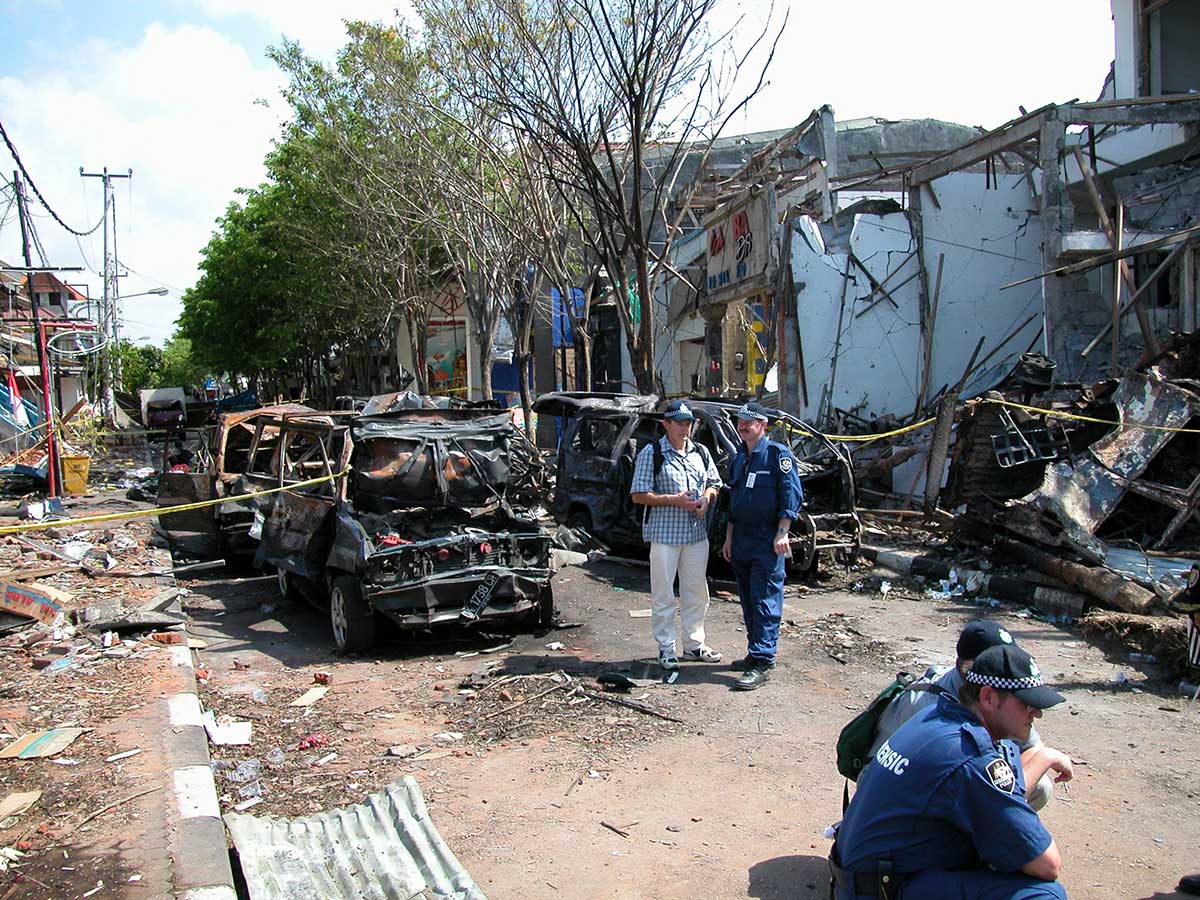
On the evening of 12 October 2002, three bombs were detonated in the Kuta tourist district of Bali, Indonesia. The first was a small device concealed in a backpack, detonated inside Paddy's Bar. As patrons fled into the street, a much larger vehicle bomb packed into a Mitsubishi L300 van exploded outside the Sari Club, a packed nightclub opposite Paddy's Bar. The blast destroyed the Sari Club entirely and caused severe damage to surrounding buildings. A third, smaller device detonated near the United States Consulate in Denpasar shortly afterward but caused only minor damage.
The attack killed 202 people, including 88 Australians, 38 Indonesians, and nationals from more than 20 other countries. Approximately 200 others were injured, many with severe burns. It was the deadliest terrorist attack in Indonesian history and the single incident that caused the most Australian casualties from terrorism.
Attribution
Indonesian authorities attributed the bombings to Jemaah Islamiyah, a jihadist network that had been established across Southeast Asia with the goal of creating an Islamic state encompassing Indonesia, Malaysia, Singapore, the southern Philippines, and Brunei. The network had operational and ideological connections to al-Qaeda. Amrozi bin Nurhasyim provided the vehicle and explosives materials, Imam Samudra coordinated the operation, and brothers Ali Ghufron (known as Mukhlas) provided ideological leadership. The principal bomb-maker was Umar Patek.
Legal Proceedings
Indonesian courts convicted numerous individuals in connection with the bombings. The three principal figures, Amrozi, Imam Samudra, and Mukhlas, were sentenced to death and executed by firing squad on 9 November 2008. Their executions were followed by security alerts across Indonesia and Australia.
Umar Patek, who fled Indonesia after the bombings and was eventually captured in Abbottabad, Pakistan in January 2011 during the same period as the search for Usama bin Laden, was extradited to Indonesia and tried. In June 2012, he was sentenced to 20 years' imprisonment, a term that was considered lenient by some given his role as the bomb-maker. He was released on parole in 2022, prompting diplomatic protest from Australia.
Context
The 2002 Bali bombings occurred against the backdrop of Indonesia's post-Suharto democratic transition and a period of intense debate within Indonesian society about the role of political Islam. Jemaah Islamiyah had been planning mass-casualty attacks against Western targets in Southeast Asia since the late 1990s. Regional intelligence cooperation between Australia, Indonesia, Singapore, and Malaysia increased substantially in the wake of the attack, as did pressure on Indonesia to prosecute JI-affiliated networks operating within its territory.
The bombings also marked a significant shift in the perception of Indonesia as a counter-terrorism partner. The Indonesian National Police's Detachment 88, established with Australian and American assistance, became the primary counter-terrorism unit in subsequent years.
Sources
- 1Bali Nightclub Bombing
EBSCO Research Starters · 2026-06-23 · Academic